
Welcome to LullaGateID™
LullaGateID is an innovative, self-hosted, license-based, and fully configurable REST API Gateway acting as a secure reverse proxy between your clients and backend services, providing authentication, authorization, and user account management via JWT and MFA without relying on third-party identity providers.
Ready-to-Deploy StackDistributed as Docker images and deployed seamlessly as containerized services.
Core System Capabilities✓ 100% self-hosted — accessible via REST API.
✓ Automatic encryption of sensitive user data via AES-256-GCM (GDPR-friendly).
✓ Built-in Key Management System (KMS) for encryption key rotation.
✓ Authorize HTTP requests from clients before forwarding them to your backend services.
✓ User registration and account confirmation.
✓ User login with MFA and logout.
✓ Configurable JWT policies and refresh token strategies.
✓ User profile updates, password changes and resets, username updates.
✓ Account deletion protected by MFA.
Get Your Free Trial License
Visit the official website to sign up, access the Admin Console, and get your free trial license.
Fully Configurable
LullaGateID allows you to configure key security-related aspects of the system.
Choose whether authentication uses access tokens alone or both access and refresh tokens.
Configure the JWT algorithm, token lifetime, signing key length, and optional refresh token rotation.
Configure which tokens are revoked when a user logs out.
Configure the MFA token length and expiration time.
System Architecture
LullaGateID relies on four core structural components:
Acts as a reverse proxy between your clients and your backend services.
Exposes a REST API used to configure the Gateway. The Gateway configuration is stored in your MySQL database.
An optional web interface that allows you to configure the Gateway through a user-friendly UI instead of making raw REST API calls with tools such as Postman.
Provided and managed by you. It stores the Gateway configuration and application data.
General Request FlowWhen an HTTP request reaches the Gateway, it must include the following headers:
App-Id,App-Key,App-Route-Id.The Gateway first validates the application by querying the database for a Tenant matching the provided
App-IdandApp-Key, and ensures that the Tenant configuration is active. It then retrieves the Route identified by the supplied
App-Route-Id, ensures that the Route configuration is active, and verifies that the Route belongs to the selected Tenant.
Finally, it verifies that the Route's path and HTTP method match those of the incoming request.Using the configuration stored in the Tenant and Route records in the database, the Gateway determines how the request should be authenticated, authorized, processed, and forwarded to the appropriate backend service.
Client Integration Patterns
Built for user-facing (browser/mobile) applications, or direct server-to-server calls.
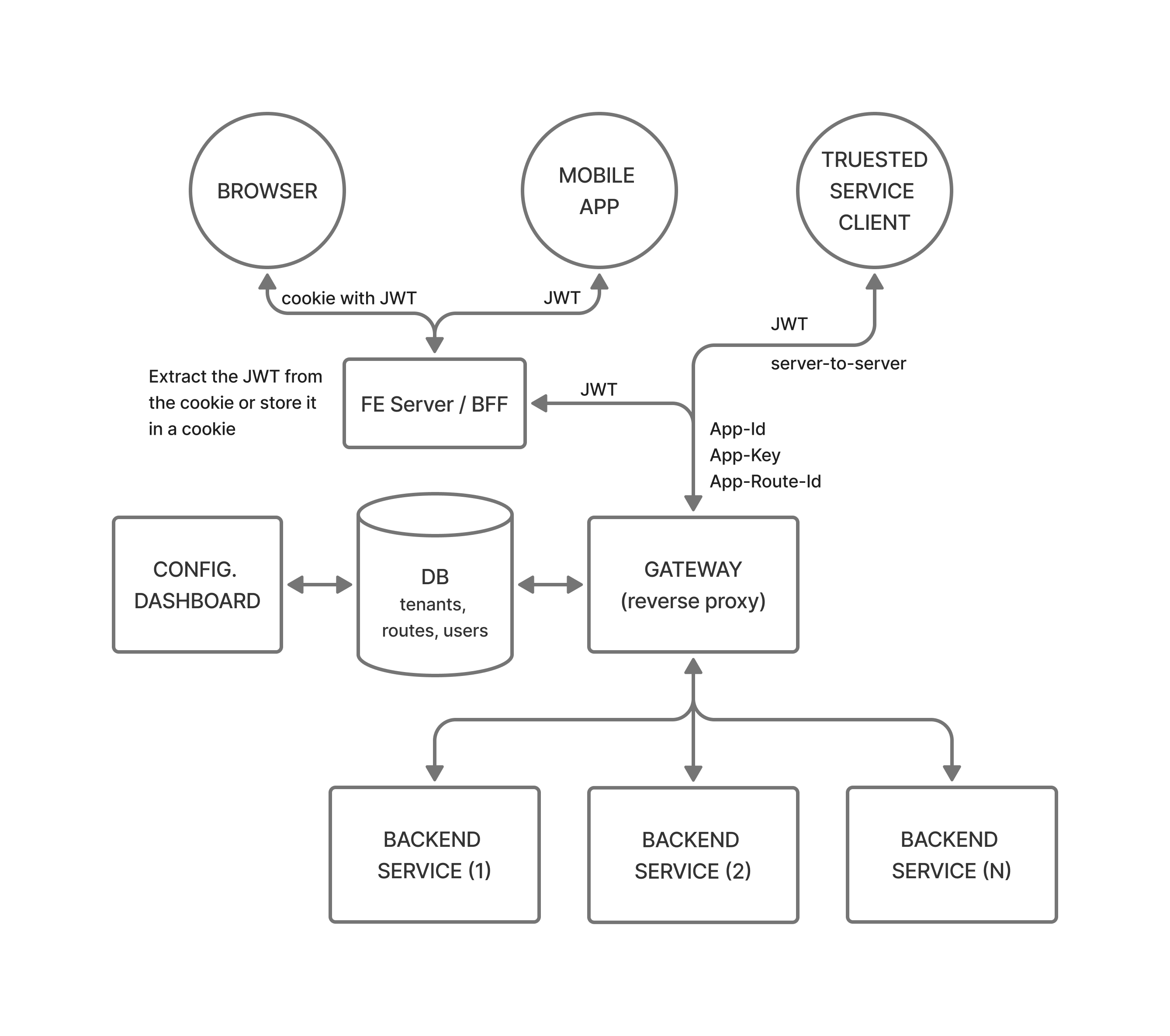
For browser-based and mobile applications, the recommended architecture is
to use a Backend-for-Frontend (BFF) layer between the client application and
the Gateway. The BFF acts as the API client of the Gateway, keeping sensitive
tenant credentials (App-Key) within a trusted server-side environment.
Client App → Backend-for-Frontend (BFF) → Gateway → Backend Services
On the other hand, trusted server-side clients, such as backend services or
other applications running in controlled environments, can communicate
directly with the LullaGateID Gateway without requiring a BFF layer.
Server Client → Gateway → Backend Services
Configuration Model
The Configuration Dashboard exposes a REST API that writes the Gateway configuration to the database. The primary configuration entities are Tenant and Route.
A Tenant represents one of your applications and is identified by an App-Id. A tenant can represent a website, a mobile application, a backend system, or any other application integrating with the Gateway.
Each tenant stores all configuration related to:
- General authentication and authorization settings.
- JWT and MFA settings.
- User account lifecycle management.
Every request that can be processed by the Gateway must have a corresponding Route. A Route is identified by an App-Route-Id and defines:
- How the request should be processed.
- How the request should be authenticated and authorized.
- The backend origin to which the request should be forwarded.
Each Route belongs to a single Tenant.
When a user signs up, their account is stored in the database.
Each user account belongs to a single Tenant.
Encryption and Key Management System (KMS)
LullaGateID protects sensitive data through encryption and secure key management.
Sensitive information stored in the database, such as user account data, is automatically encrypted using AES-256-GCM, helping meet GDPR security requirements.
LullaGateID includes a built-in Key Management System that enables encryption key rotation, supporting security and compliance best practices.
Updated about 3 hours ago